


Short link: https://wp.me/paaccn-zHl
Kaspersky’s detection systems discovered an average of 411,000 malicious files every day, with an increase of nearly three percent in 2023, compared to the previous year.
Particular types of threats also escalated: experts observed a marked surge of 53 percent in attacks involving malicious Microsoft Office and other types of documents. Attackers leaned towards more dangerous tactics, such as utilizing backdoors to infiltrate systems undetected. These insights, detailed in the Kaspersky Security Bulletin: Statistics of the Year Report, underscore the evolving landscape of cyberthreats.
In 2023, Kaspersky’s systems detected almost 125 million malicious files in total. Windows continued to be the primary target for cyberattacks, accounting for 88 percent of all malware-filled data detected daily. Malicious families disseminated through various scripts and different document formats ranked among the top three threats, accounting for 10 percent of all malicious files detected daily.

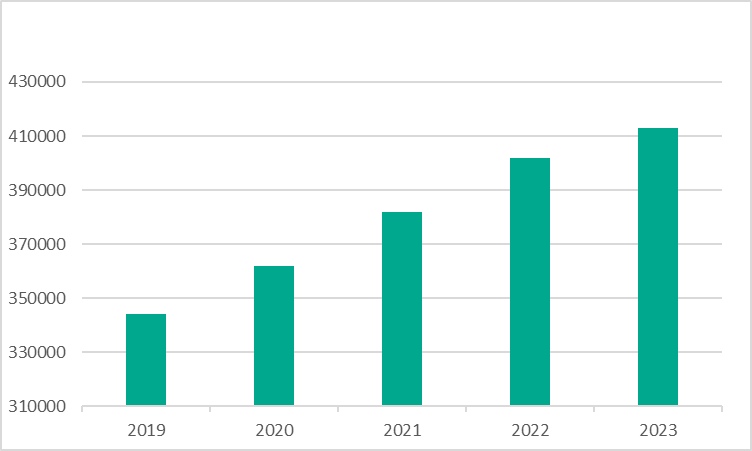
Average daily number of malicious files detected by Kaspersky security solutions from 2019 to 2023 (1st January – 31st October)
Kaspersky’s detection systems discovered a rather significant daily increase of malicious files in various document formats – for instance, Microsoft Office, PDF, etc. – rising by 53 percent to about 24,000 files. The growth may be linked to a rise in attacks utilizing phishing PDF files, designed to pilfer data from potential victims.
The most widespread type of malware continues to be trojans. This year, there has been a notable uptick in the use of backdoors, registering a growth from 15,000 detected files per day in 2022 to 40,000 in 2023. Backdoors stand out as one of the most hazardous types of trojans, providing attackers with remote control over a victims’ system to carry out tasks such as sending, receiving, executing, and deleting files, as well as harvesting confidential data and logging computer activity.
“The cyberthreat landscape continues to evolve, becoming more dangerous year after year. Adversaries continue to develop new malware, techniques, and methods to attack organizations and individuals. The number of vulnerabilities reported is also growing annually, and threat actors including ransomware gangs use them without hesitating. Furthermore, the entry barrier into cybercrime is now being lowered due to the proliferation of AI, which attackers use, for example, to create phishing messages with more convincing texts. In these times, it is essential both for large organizations and for every regular user to embrace reliable security solutions. Kaspersky experts are dedicated to tackling these ever-evolving cyberthreats, ensuring a secure online experience for users every day and providing vital threat intelligence about relevant threats,” comments Vladimir Kuskov, head of Anti-Malware Research at Kaspersky.


The discoveries are based on Kaspersky detections of malicious files from January to October and are part of Kaspersky Security Bulletin (KSB) – an annual series of predictions and analytical reports on key shifts within the cybersecurity world. Follow this link to learn more about other KSB pieces.
To stay protected, Kaspersky also recommends users the following:
-
Do not download and install applications from untrusted sources
-
Do not click on any links from unknown sources or suspicious online advertisements
-
Create strong and unique passwords, including a mix of lower-case and upper-case letters, numbers, and punctuation, as well as activating two-factor authentication
-
Always install updates. Some of them may contain critical security issue fixes
-
Ignore messages asking to disable security systems for office or cybersecurity software
-
Use a robust security solution appropriate to your system type and devices, such as Kaspersky Premium.
To stay safe, Kaspersky recommends organizations to:
-
Always keep software updated on all the devices you use to prevent attackers from infiltrating your network by exploiting vulnerabilities.
-
Establish the practice of using strong passwords to access corporate services. Use multi-factor authentication for access to remote services.
-
Choose a proven endpoint security solution such as Kaspersky Endpoint Security for Business that is equipped with behavior-based detection and anomaly control capabilities for effective protection against known and unknown threats.
-
Use a dedicated set for effective endpoint protection, threat detection and response products to timely detect and remediate even new and evasive threats. Kaspersky Optimum Security the essential set of endpoint protection empowered with EDR and MDR.
-
Use the latest Threat Intelligence information to stay aware of actual TTPs used by threat actors. (/)